First Black Bermudian to head the government of Bermuda and the first Premier of Bermuda.
Who We Are
- The Inner Temple Today
- Bench Table Orders
- Education and Qualification Rules
- Consultation Responses
- Time to Change
- Social Mobility Employer Index
- The Council of the Inns of Court
- Anti-Bribery
- Applications Misconduct Policy
- Car Park Terms and Conditions
- Equality & Diversity
- Freedom of Information
- Complaints
- Licensing
- Conflicts of Interest
- PASS Travel, Accommodation and Subsistence Policy
- Privacy
- Outreach Safeguarding Policy
- 🔗 Searcys Anti-Slavery Policy
- Scholarships Feedback Policy
- Scholarships Deferrals Policy
- Modern Slavery and Human Trafficking Policy
- Environmental Policy
- Scholarships Appeals Policy
- Pupils Advocacy Course Appeals Policy
- Sponsorship for Student Societies
- Social Media for Student Societies
- Volunteer and Participant Code of Conduct
- We Are a Living Wage Employer
- Admissions Database 1547-1940
- The Archives
- Bench Table Orders 1845-1945
- Calendars of Inner Temple Records 1505-1845
- Introduction
- Diversity Timeline
- Edward Akufo-Addo
- Obafemi Awolowo
- Joyce Bamford-Addo
- Solomon Brandaranaike
- Charlotte Boaitey-Kwarteng
- Joseph Ephraim Casely Hayford
- Eugenia Charles
- S Chelvan
- Thomas Morris Chester
- Learie Constantine
- Edward Cragg Haynes
- Patricia Dangor
- Coomee Rustom Dantra
- Gifty Edila
- Ezlynn Deraniyagala
- Taslim Olawale Elias
- Martin Forde
- Arthur Dion Hanna
- Ma Pwa Hmee
- Alexander Isbister
- Sibghatullah Kadri
- Seretse Kharma
- Moleleki Didwell Mokama
- Tunde Okewale
- Ashitey Ollennu
- Vallabhbhai Patel
- Lily Tie Ten Quee
- Ponnambalam Ramanathan
- Edward Richards
- Khushwant Singh
- Manjiit Singh Gill
- Teo Soon Kim
- Leslie Thomas
- Stella Thomas
- Leonard Woodley
- The Christmas Accounts 1614-82
- The Freehold
- Charles and Mary Lamb in the Inner Temple
- Grand Day
- Life in Halls: Designs of the Previous Incarnations of the Inner Temple Hall
- Gorboduc, or the Tragedy of Ferrex and Porrox
- Lord Robert Dudley, 'chief patron and defender' of the Inner Temple
- Lost in the Past : The Rediscovered Archives of Clifford's Inn
- Paintings
- Phoenix from the Ashes: The Post-War Reconstruction Of The Inner Temple
- Silver - Extract from 'A Community of Communities'
- The "Unfortunate Marriage" of Seretse Khama
- The admission of overseas students to the Inner Temple in the 19th century
- The Inns Of Court & Inns Of Chancery & their Records
- William Cowper of the Inner Temple
- William Niblett - A Life Re-Examined
- History of The Inner Temple Video
- Library Manuscripts
- Magna Carta Timeline
- Paintings Collection
- Pegasus Emblem
- Silver Collection
- Introduction
- Timeline
- Joyce Bamford-Addo
- Marion Billson
- Jill Black
- Elizabeth Butler-Sloss
- Sue Carr
- Eugenia Charles
- Lynda Clark
- Freda Corbet
- Coomee Rustom Dantra
- Leeona Dorrian
- Heather Hallett
- Frene Ginwala
- Rosalyn Higgins
- Daw Phar Hmee
- Lim Beng Hong
- Dorothy Knight Dix
- Sara Lawson
- Elizabeth Lane
- Theodora Llewelyn Davies
- Gladys Ramsarran
- Lucy See
- Evelyn Sharp
- Victoria Sharp
- Ingrid Simler
- Teo Soon Kim
- Ivy Williams
- The Significance of the Sex Disqualification (Removal) Act 1919
- Women in Law Podcasts
- Notable Members
- Our People
- Work for Us
Home › Who We Are › History › Celebrating Diversity at the Bar › Edward Richards
Sir Edward Richards
1908 – 1991
Call 1946, Middle Temple
Born in British Guiana (Guyana) in 1908, Edward Trenton (E.T.) Richards grew up in a society where Black, White, Indian, Portuguese, Chinese and Amerindian lived without racial discrimination. This determined the crucial foundation of his character. He carried into his adult life a strong belief that discrimination was an injustice, detrimental to black people and disadvantageous to the whole community.
By the age of 15, E.T.’s goal was to go to England to study law. He had excelled at Queen’s College in Guiana and then qualified as a teacher. Unfortunately his salary was insufficient to fund further education abroad. He therefore took the opportunity of a better paid teaching position in Bermuda.
He was twenty-one when he arrived in Bermuda in 1930. He was outraged to find an island ruled by a powerful white oligarchy, entrenched in its racial divide and segregated at all levels, including the Church. He threw himself into improving the opportunities and aspirations of the students at his segregated black school. In 1933, he also became the assistant editor of the only black-owned newspaper, The Bermuda Recorder, where he was an outspoken and fearless critic of the island’s discriminatory systems and practices.
In 1943, amid U boats patrolling the North Atlantic, E.T. joined a convoy of 90 ships bound for England, leaving behind his wife and 3-month-old baby, arriving in London during the war. He experienced London being bombed.
He became a member of the Middle Temple in order to study law. He was funded by renting his home in Bermuda. He was called to the Bar at the Middle Temple in November 1946. In 1947, at the age of 39, he was called to the Bermuda Bar and set up as sole practitioner, E.T. Richards, Barrister and Attorney-at-law.
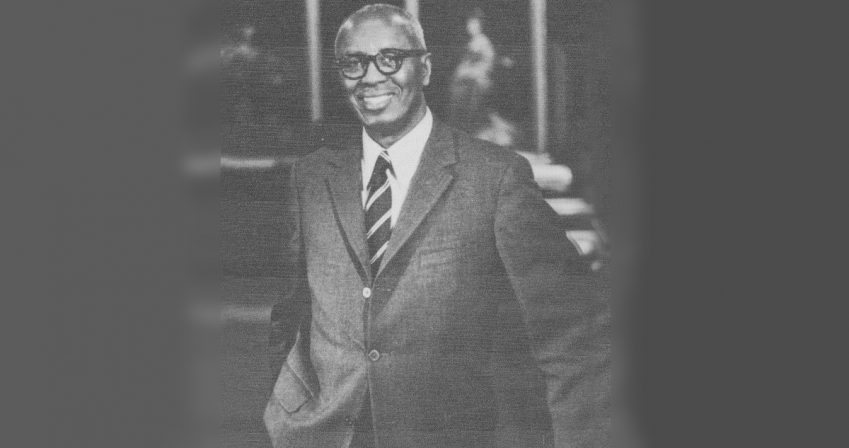
Sir Edward Richards
A year after his return, E.T. was elected to a Parliament deeply divided along racial lines dominated by a white majority. Throughout his long career, both in his legal practice and in parliament, E.T. worked tirelessly for racial justice and equality for the black people. He spoke passionately in parliamentary debates and behind the scenes in committees to persuade the hardliners to pass anti-discriminatory laws, just and fair for all. These laws included universal voting rights for all Bermudians regardless of race, gender and property ownership, the abolition of segregation in schools, cinemas, restaurants, hotels and the post office. He enabled black nurses to train abroad and black doctors to practise in the hospital.
E.T. was appointed the first black magistrate and, in 1971, he became Bermuda’s first black government Leader, officially renamed Premier in 1973, a position he held until he retired from politics in 1975.
He was knighted in 1970. In 1975, on the Queen’s second visit to Bermuda, Sir Edward introduced to her parliamentarians and dignitaries of all races with whom she dined. This was in stark contrast to the Queen’s visit in 1953 when no black people were invited to meet her. This is a testament to the legislative and societal changes Sir Edward had effected.
In 1975 Sir Edward retired from politics. He became a founding member of the firm of Richards, Francis & Francis where he worked until his retirement in 1986. He continued to encourage and support many of his former students in their various professional capacities.
Honesty, Integrity, Logic, whether in education, journalism, law or politics, these were the guiding principles of Sir Edward’s life.
Sir Edward Richards died in 1991 and in 2015 was declared a National Hero by the Government and people of Bermuda.
Written by his daughter, Judge Patricia Dangor