First QC, Recorder of the Crown Court and Bencher of Afro-Caribbean heritage in the UK.
Who We Are
- The Inner Temple Today
- Bench Table Orders
- Education and Qualification Rules
- Consultation Responses
- Time to Change
- Social Mobility Employer Index
- The Council of the Inns of Court
- Anti-Bribery
- Applications Misconduct Policy
- Car Park Terms and Conditions
- Equality & Diversity
- Freedom of Information
- Complaints
- Licensing
- Conflicts of Interest
- Scholarships Travel Reimbursement Policy
- PASS Travel, Accommodation and Subsistence Policy
- Privacy
- Outreach Safeguarding Policy
- 🔗 Searcys Anti-Slavery Policy
- Scholarships Feedback Policy
- Scholarships Deferrals Policy
- Modern Slavery and Human Trafficking Policy
- Environmental Policy
- Scholarships Appeals Policy
- Pupils Advocacy Course Appeals Policy
- Sponsorship for Student Societies
- Social Media for Student Societies
- Volunteer and Participant Code of Conduct
- We Are a Living Wage Employer
- Admissions Database 1547-1940
- The Archives
- Bench Table Orders 1845-1945
- Calendars of Inner Temple Records 1505-1845
- Introduction
- Diversity Timeline
- Edward Akufo-Addo
- Obafemi Awolowo
- Joyce Bamford-Addo
- Solomon Brandaranaike
- Charlotte Boaitey-Kwarteng
- Joseph Ephraim Casely Hayford
- Eugenia Charles
- S Chelvan
- Thomas Morris Chester
- Learie Constantine
- Edward Cragg Haynes
- Patricia Dangor
- Coomee Rustom Dantra
- Gifty Edila
- Ezlynn Deraniyagala
- Taslim Olawale Elias
- Martin Forde
- Arthur Dion Hanna
- Ma Pwa Hmee
- Alexander Isbister
- Sibghatullah Kadri
- Seretse Kharma
- Moleleki Didwell Mokama
- Tunde Okewale
- Ashitey Ollennu
- Vallabhbhai Patel
- Lily Tie Ten Quee
- Ponnambalam Ramanathan
- Edward Richards
- Khushwant Singh
- Manjiit Singh Gill
- Teo Soon Kim
- Leslie Thomas
- Stella Thomas
- Leonard Woodley
- The Christmas Accounts 1614-82
- The Freehold
- Charles and Mary Lamb in the Inner Temple
- Grand Day
- Life in Halls: Designs of the Previous Incarnations of the Inner Temple Hall
- Gorboduc, or the Tragedy of Ferrex and Porrox
- Lord Robert Dudley, 'chief patron and defender' of the Inner Temple
- Lost in the Past : The Rediscovered Archives of Clifford's Inn
- Paintings
- Phoenix from the Ashes: The Post-War Reconstruction Of The Inner Temple
- Silver - Extract from 'A Community of Communities'
- The "Unfortunate Marriage" of Seretse Khama
- The admission of overseas students to the Inner Temple in the 19th century
- The Inns Of Court & Inns Of Chancery & their Records
- William Cowper of the Inner Temple
- William Niblett - A Life Re-Examined
- History of The Inner Temple Video
- Library Manuscripts
- Magna Carta Timeline
- Paintings Collection
- Pegasus Emblem
- Silver Collection
- Introduction
- Timeline
- Joyce Bamford-Addo
- Marion Billson
- Jill Black
- Elizabeth Butler-Sloss
- Sue Carr
- Eugenia Charles
- Lynda Clark
- Freda Corbet
- Coomee Rustom Dantra
- Leeona Dorrian
- Heather Hallett
- Frene Ginwala
- Rosalyn Higgins
- Daw Phar Hmee
- Lim Beng Hong
- Dorothy Knight Dix
- Sara Lawson
- Elizabeth Lane
- Theodora Llewelyn Davies
- Gladys Ramsarran
- Lucy See
- Evelyn Sharp
- Victoria Sharp
- Ingrid Simler
- Teo Soon Kim
- Ivy Williams
- The Significance of the Sex Disqualification (Removal) Act 1919
- Women in Law Podcasts
- Notable Members
- Our People
- Work for Us
Home › Who We Are › History › Celebrating Diversity at the Bar › Leonard Woodley
Leonard Woodley QC
1927 - 2020
Call 1963, Inner Temple
Leonard Woodley was born in Port of Spain, Trinidad and Tobago, in 1927. Raised by his paternal Grandmother, and an alumnus of the prestigious St Mary’s College, he demonstrated well rounded abilities in academia, music, and sport. After leaving school he became clerk, then commercial administrator, and it was during this time he met his first wife Lorna Bridgemohan. Together they had five children.
Leonard had a strong desire to study law and regretted that his schoolteachers didn’t support his academic ambitions. But in 1960, while in his early thirties, Leonard travelled to London where he initially took a diploma in international affairs at the University of London, and remarkably, was called to the Bar in 1963.
Leonard began practising in the chambers of Labour MP Dingle Foot and specialised in criminal law often dealing with cases which had a political or civil liberties element. He became involved in the famous cases of the Mangrove Nine (1970), cases relating to 1981 England Riots and the trial of the Newham Eight (1983). Leonard was made QC in 1988, becoming the first Black barrister to hold this position.
In spite of the many barriers broken to establish his legal career, this did not shield him from the racism he encountered in his professional and personal life. There were various instances of this which included being stopped by police while driving an open top car, reported to security by another judge wondering ‘why a black man was parking in the lot reserved for benchers’ and being accused of fraud when trying to withdraw cash from a bank. Before getting married to his second wife, Jennifer Bishop, (his first marriage ended in divorce after he moved to England) her father objected to the marriage on grounds of his race and cut all ties with the couple.
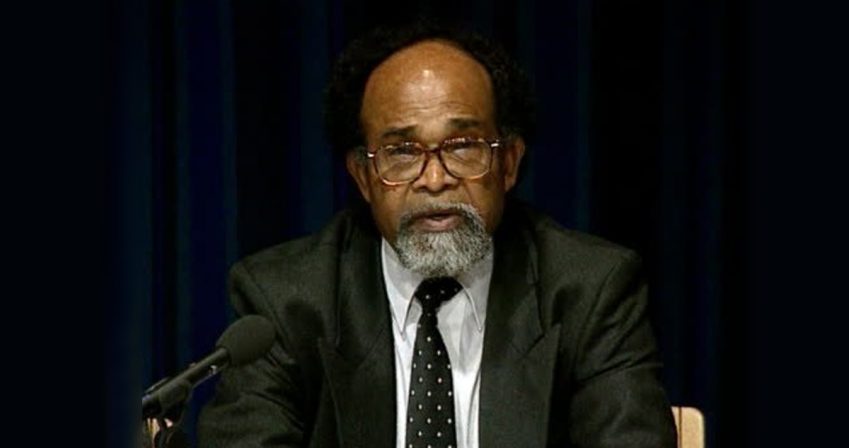
Leonard Woodley QC
When Leonard started practising, it was time of great political and social turmoil around the world, and though he may not have been a front and centre activist, he used his position and influence in the courts to advance the lives of people of colour and vulnerable people in society. Whilst head of the John Benson’s Chamber (now known as 1MCB), the most ethnically diverse chambers at the Bar, he marked his support for the anti-apartheid struggle by inviting Nelson Mandela to be an honorary door tenant. Mandela accepted this honor, while serving a life sentence, and his name remained on the door until he became President of South Africa. The Leonard Woodley scholarship was established to support Black pupils at the Inner Temple and is still awarded to pupils today. Leonard’s compassion was also reflected during his time as Recorder sitting in the Crown Court (between 1989 and 2000), where he would always opt for non-custodial sentences if possible, and quietly ignored criticism of this approach.
Further into his career he chaired the 1995 Laudat inquiry, an investigation into a murder committed by an ex-prisoner released into the community without receiving adequate care or supervision. The report criticized several holes in the health care system and addressed poor communication between health workers, social workers, and prison authorities. In 1997 Leonard sat on the Royal Commission on long term care for the elderly, which examined the sustainable options for a system of funding for long-term care of elderly people.
Leonard Woodley died in January 2020.
Ayah Al-Rawni