First woman in Jamaica to be called to the Bar.
Who We Are
- The Inner Temple Today
- Bench Table Orders
- Education and Qualification Rules
- Consultation Responses
- Time to Change
- Social Mobility Employer Index
- The Council of the Inns of Court
- Anti-Bribery
- Applications Misconduct Policy
- Car Park Terms and Conditions
- Equality & Diversity
- Freedom of Information
- Complaints
- Licensing
- Conflicts of Interest
- PASS Travel, Accommodation and Subsistence Policy
- Privacy
- Outreach Safeguarding Policy
- 🔗 Searcys Anti-Slavery Policy
- Scholarships Feedback Policy
- Scholarships Deferrals Policy
- Modern Slavery and Human Trafficking Policy
- Environmental Policy
- Scholarships Appeals Policy
- Pupils Advocacy Course Appeals Policy
- Sponsorship for Student Societies
- Social Media for Student Societies
- Volunteer and Participant Code of Conduct
- We Are a Living Wage Employer
- Admissions Database 1547-1940
- The Archives
- Bench Table Orders 1845-1945
- Calendars of Inner Temple Records 1505-1845
- Introduction
- Diversity Timeline
- Edward Akufo-Addo
- Obafemi Awolowo
- Joyce Bamford-Addo
- Solomon Brandaranaike
- Charlotte Boaitey-Kwarteng
- Joseph Ephraim Casely Hayford
- Eugenia Charles
- S Chelvan
- Thomas Morris Chester
- Learie Constantine
- Edward Cragg Haynes
- Patricia Dangor
- Coomee Rustom Dantra
- Gifty Edila
- Ezlynn Deraniyagala
- Taslim Olawale Elias
- Martin Forde
- Arthur Dion Hanna
- Ma Pwa Hmee
- Alexander Isbister
- Sibghatullah Kadri
- Seretse Kharma
- Moleleki Didwell Mokama
- Tunde Okewale
- Ashitey Ollennu
- Vallabhbhai Patel
- Lily Tie Ten Quee
- Ponnambalam Ramanathan
- Edward Richards
- Khushwant Singh
- Manjiit Singh Gill
- Teo Soon Kim
- Leslie Thomas
- Stella Thomas
- Leonard Woodley
- The Christmas Accounts 1614-82
- The Freehold
- Charles and Mary Lamb in the Inner Temple
- Grand Day
- Life in Halls: Designs of the Previous Incarnations of the Inner Temple Hall
- Gorboduc, or the Tragedy of Ferrex and Porrox
- Lord Robert Dudley, 'chief patron and defender' of the Inner Temple
- Lost in the Past : The Rediscovered Archives of Clifford's Inn
- Paintings
- Phoenix from the Ashes: The Post-War Reconstruction Of The Inner Temple
- Silver - Extract from 'A Community of Communities'
- The "Unfortunate Marriage" of Seretse Khama
- The admission of overseas students to the Inner Temple in the 19th century
- The Inns Of Court & Inns Of Chancery & their Records
- William Cowper of the Inner Temple
- William Niblett - A Life Re-Examined
- History of The Inner Temple Video
- Library Manuscripts
- Magna Carta Timeline
- Paintings Collection
- Pegasus Emblem
- Silver Collection
- Introduction
- Timeline
- Joyce Bamford-Addo
- Marion Billson
- Jill Black
- Elizabeth Butler-Sloss
- Sue Carr
- Eugenia Charles
- Lynda Clark
- Freda Corbet
- Coomee Rustom Dantra
- Leeona Dorrian
- Heather Hallett
- Frene Ginwala
- Rosalyn Higgins
- Daw Phar Hmee
- Lim Beng Hong
- Dorothy Knight Dix
- Sara Lawson
- Elizabeth Lane
- Theodora Llewelyn Davies
- Gladys Ramsarran
- Lucy See
- Evelyn Sharp
- Victoria Sharp
- Ingrid Simler
- Teo Soon Kim
- Ivy Williams
- The Significance of the Sex Disqualification (Removal) Act 1919
- Women in Law Podcasts
- Notable Members
- Our People
- Work for Us
Home › Who We Are › History › Celebrating Diversity at the Bar › Lily Tie Ten Quee
Lily Tie Ten Quee
Lily Tie Ten Quee, was the daughter of a successful Chinese businessman in Jamaica who had emigrated to the island from China at the turn of the 20th century. Her father was the first Chinese magistrate on the island, her uncle was the first Chinese solicitor and her brother also became a solicitor.
An alumnus of Newnham College, Cambridge, at a time when women were not recognised as ‘full members’ of the university and only given ‘title of a degree’ and could not go to Senate House to receive the degree in person. None the less she graduated, and in 1933 and became Jamaica’s first woman to be called to the Bar. Even in Britain, there were relatively few women barristers, and only one other woman was called on the same day. Lily Tie Ten Quee recalls that at the formal students’ dinners in Middle Temple Hall, male and female diners were kept apart and as she was often the only woman there, this meant she dined as she put it in ‘solitary splendour’.
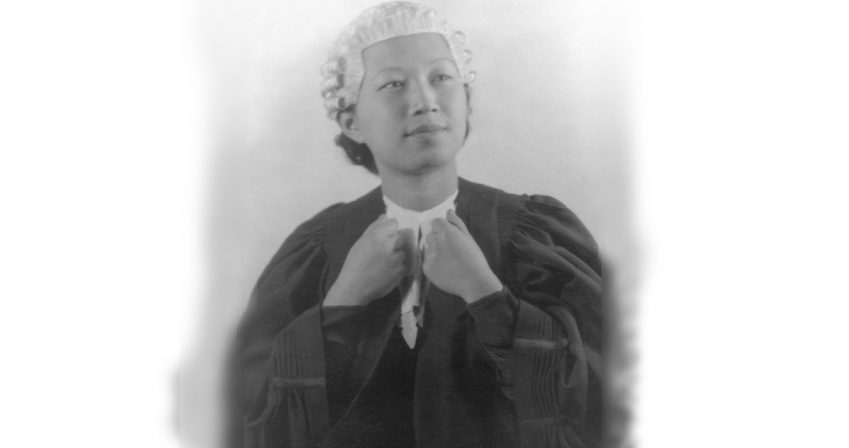
Lenli Tie Ten Quee
When Lily became a barrister, there was a huge celebration in Jamaica to mark the occasion and her father hoped that she would join the family firm of lawyers. However, she wanted to re-connect with her Chinese roots and at a reception in Kingston in 1934, she publicly declared her intention to dedicate her life to the development of China as a modern country. That same year, she went to Nanking, then the capital of China under the Nationalist government of Chiang-Kai-Shek and was given a job at the Central Political Institute (CPI), that had Chiang-Kai-Shek as its president, to teach jurisprudence and English literature. The CPI was a training college for graduates of other universities and trained diplomats and magistrates.
But history thwarted her plans to stay in China. She found herself obliged to return to Britain in 1936, just ahead of the Nanking massacre when an estimated 150,000-300,000 people were executed, and thousands of women raped by the invading Japanese forces.
She married the Cambridge University jurist and legal scholar Richard Meredith Jackson (The Machinery of Justice in England which is still in print today) later that year.
During the Second World War, she worked in the legal department of the Ministry of Supply. After the war, she made annual visits to Jamaica to visit her mother but she continued to live in Cambridge until her death in 1991. She offered hospitality to a great number of Chinese students at Cambridge University. Among her many activities, she worked at the Legal Advice Centre that was run by Cambridge’s Citizens Advice Bureau. She had a son, Shean and a daughter, Mei-Ling. Shean read for the Bar but decided to go and live in Jamaica where he was killed in a road accident in 1968.