Nigerian nationalist and statesman who played a key role in Nigeria's independence movement.
Who We Are
- The Inner Temple Today
- Bench Table Orders
- Education and Qualification Rules
- Consultation Responses
- Time to Change
- Social Mobility Employer Index
- The Council of the Inns of Court
- Anti-Bribery
- Applications Misconduct Policy
- Car Park Terms and Conditions
- Equality & Diversity
- Freedom of Information
- Complaints
- Licensing
- Conflicts of Interest
- PASS Travel, Accommodation and Subsistence Policy
- Privacy
- Outreach Safeguarding Policy
- 🔗 Searcys Anti-Slavery Policy
- Scholarships Feedback Policy
- Scholarships Deferrals Policy
- Modern Slavery and Human Trafficking Policy
- Environmental Policy
- Scholarships Appeals Policy
- Pupils Advocacy Course Appeals Policy
- Sponsorship for Student Societies
- Social Media for Student Societies
- Volunteer and Participant Code of Conduct
- We Are a Living Wage Employer
- Admissions Database 1547-1940
- The Archives
- Bench Table Orders 1845-1945
- Calendars of Inner Temple Records 1505-1845
- Introduction
- Diversity Timeline
- Edward Akufo-Addo
- Obafemi Awolowo
- Joyce Bamford-Addo
- Solomon Brandaranaike
- Charlotte Boaitey-Kwarteng
- Joseph Ephraim Casely Hayford
- Eugenia Charles
- S Chelvan
- Thomas Morris Chester
- Learie Constantine
- Edward Cragg Haynes
- Patricia Dangor
- Coomee Rustom Dantra
- Gifty Edila
- Ezlynn Deraniyagala
- Taslim Olawale Elias
- Martin Forde
- Arthur Dion Hanna
- Ma Pwa Hmee
- Alexander Isbister
- Sibghatullah Kadri
- Seretse Kharma
- Moleleki Didwell Mokama
- Tunde Okewale
- Ashitey Ollennu
- Vallabhbhai Patel
- Lily Tie Ten Quee
- Ponnambalam Ramanathan
- Edward Richards
- Khushwant Singh
- Manjiit Singh Gill
- Teo Soon Kim
- Leslie Thomas
- Stella Thomas
- Leonard Woodley
- The Christmas Accounts 1614-82
- The Freehold
- Charles and Mary Lamb in the Inner Temple
- Grand Day
- Life in Halls: Designs of the Previous Incarnations of the Inner Temple Hall
- Gorboduc, or the Tragedy of Ferrex and Porrox
- Lord Robert Dudley, 'chief patron and defender' of the Inner Temple
- Lost in the Past : The Rediscovered Archives of Clifford's Inn
- Paintings
- Phoenix from the Ashes: The Post-War Reconstruction Of The Inner Temple
- Silver - Extract from 'A Community of Communities'
- The "Unfortunate Marriage" of Seretse Khama
- The admission of overseas students to the Inner Temple in the 19th century
- The Inns Of Court & Inns Of Chancery & their Records
- William Cowper of the Inner Temple
- William Niblett - A Life Re-Examined
- History of The Inner Temple Video
- Library Manuscripts
- Magna Carta Timeline
- Paintings Collection
- Pegasus Emblem
- Silver Collection
- Introduction
- Timeline
- Joyce Bamford-Addo
- Marion Billson
- Jill Black
- Elizabeth Butler-Sloss
- Sue Carr
- Eugenia Charles
- Lynda Clark
- Freda Corbet
- Coomee Rustom Dantra
- Leeona Dorrian
- Heather Hallett
- Frene Ginwala
- Rosalyn Higgins
- Daw Phar Hmee
- Lim Beng Hong
- Dorothy Knight Dix
- Sara Lawson
- Elizabeth Lane
- Theodora Llewelyn Davies
- Gladys Ramsarran
- Lucy See
- Evelyn Sharp
- Victoria Sharp
- Ingrid Simler
- Teo Soon Kim
- Ivy Williams
- The Significance of the Sex Disqualification (Removal) Act 1919
- Women in Law Podcasts
- Notable Members
- Our People
- Work for Us
Home › Who We Are › History › Celebrating Diversity at the Bar › Obafemi Awolowo
Obafemi Awolowo
1909 – 1987
Call 1946, Inner Temple
Chief Jeremiah Obafemi Awolowo, was born on 6 March 1909 in Ogun State, Nigeria. He did not come from a privileged background and is said to have been the first person in his family to attend school and university.
Awolowo was a devout Christian and democratic socialist. He lost his father at a young age and worked at various times as a farmer, produce broker, teacher, typist, clerk and journalist. He attended Wesley College, Ibadan, Nigeria and obtained a law degree from the University of London. He was admitted by The Inner Temple on 22 May 1944, and called to the English Bar on 19 November 1946.
He was the author of several books including Path to Freedom published by Faber, London 1947. He returned to Nigeria the same year and went on to establish a successful legal career as a Senior Advocate, politician and entrepreneur.
During the colonial period, Awolowo was an active member of the Nigerian Youth Movement, which was the first Nigerian, nationalist organization, favoured by the educated elite and opposed indirect British rule. In or around 1945 he established a non-political group called the Descendants of Oduduwa to mobilise and unify all the Yoruba people, one of the largest, Nigerian, ethnic groups. In 1949, he also established the Nigerian Tribune, which played a pivotal role in the nationalist movement and is today, Nigeria’s oldest independently owned, private newspaper.
In 1951, in order to contest elections, he established and led the Action Group ‘AG’ whose motto was ‘Freedom for All and Life more Abundance.' The party’s ideology was based on the importance of education and the development of welfare, public goods and services for everyone.
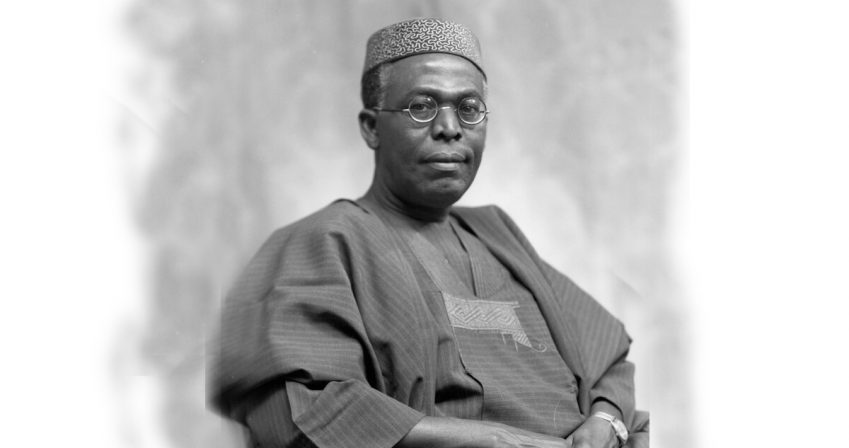
Obafemi Awolowo Obafemi Awolowo by Bassano Ltd Image Source: https://www.npg.org.uk/collections/search/portrait/mw89467/
“Awo” as he was popularly called, became the first indigenous Premier of the Western Region in 1954. His administration was renowned for a number of firsts including free primary education for all and free healthcare for children in the Western Region, 1955. Each was the first of its kind in Africa. He introduced a minimum wage in the Western Region, the first Television station in Africa, Western Nigeria Television, ‘W.N.T.V,’ 1959; Obafemi Awolowo Stadium, originally Liberty Stadium, 1960, and he laid the foundation for Cocoa House, the first skyscraper in Nigeria and West Africa, 1965.
Awolowo was a nationalist and one of the founding fathers of Nigeria’s independence in 1960. He was unsuccessful in the 1959 elections which he lost to Sir Abubakar Tafawa Balewa KBE PC, Nigeria’s first and only Prime Minister. After independence, he became the leader of the opposition.
Awolowo was passionate about education and the establishment of one the country’s top, pioneering universities; Obafemi Awolowo University, ‘OAU’ formerly University of Ife, named after him, posthumously in 198, was his brainchild. He was also its first Chancellor.
The post-colonial architecture of OAU was designed by Israeli, Arieh Sharon and a team of Nigerian architects. The campus featured in Bauhaus’ Centenary exhibition 2019, where it was described as
a symbol of Nigeria’s independence from Britain, a modernist university and product of politics, design and climate as well as being a social stage for community and education.
Noble Prize winner, Professor Wole Soyinka was professor of comparative literature at OAU from 1975 to 1999.
In 1963, Awolowo was imprisoned for conspiracy to overthrow the government but following a military pardon by General Yakubu Gowon in 1966, he was made the Federal Commissioner of Finance and Vice Chairman of the Federal Executive Council. The Nigerian Naira which replaced the Nigerian pound in 1973 was coined by Awolowo and he is featured on the one hundred naira note which was issued by Nigeria Central Bank in 1999 and is still in circulation.
In 1978, Awolowo established the Unity Party of Nigeria ‘UPN’ based on similar ideology to the Action Group and made two further unsuccessful bids for the presidency in 1979 and 1983 before retiring from politics.
Awolowo was a statesman and visionary, a man of ideas and action. In 1982, he was awarded the Grand Commander of the Federal Republic of Nigeria, ‘GCFR’, Nigeria’s highest honour by President Shehu Shagari in recognition of his achievements and contributions to the Federation. He is fondly remembered as the first leader of the Yoruba and often described as,
the best President Nigeria never had.
Paula Sofowora