Barrister, Activist and Statesman.
Who We Are
- The Inner Temple Today
- Bench Table Orders
- Education and Qualification Rules
- Consultation Responses
- Time to Change
- Social Mobility Employer Index
- The Council of the Inns of Court
- Anti-Bribery
- Applications Misconduct Policy
- Car Park Terms and Conditions
- Equality & Diversity
- Freedom of Information
- Complaints
- Licensing
- Conflicts of Interest
- PASS Travel, Accommodation and Subsistence Policy
- Privacy
- Outreach Safeguarding Policy
- 🔗 Searcys Anti-Slavery Policy
- Scholarships Feedback Policy
- Scholarships Deferrals Policy
- Modern Slavery and Human Trafficking Policy
- Environmental Policy
- Scholarships Appeals Policy
- Pupils Advocacy Course Appeals Policy
- Sponsorship for Student Societies
- Social Media for Student Societies
- Volunteer and Participant Code of Conduct
- We Are a Living Wage Employer
- Admissions Database 1547-1940
- The Archives
- Bench Table Orders 1845-1945
- Calendars of Inner Temple Records 1505-1845
- Introduction
- Diversity Timeline
- Edward Akufo-Addo
- Obafemi Awolowo
- Joyce Bamford-Addo
- Solomon Brandaranaike
- Charlotte Boaitey-Kwarteng
- Joseph Ephraim Casely Hayford
- Eugenia Charles
- S Chelvan
- Thomas Morris Chester
- Learie Constantine
- Edward Cragg Haynes
- Patricia Dangor
- Coomee Rustom Dantra
- Gifty Edila
- Ezlynn Deraniyagala
- Taslim Olawale Elias
- Martin Forde
- Arthur Dion Hanna
- Ma Pwa Hmee
- Alexander Isbister
- Sibghatullah Kadri
- Seretse Kharma
- Moleleki Didwell Mokama
- Tunde Okewale
- Ashitey Ollennu
- Vallabhbhai Patel
- Lily Tie Ten Quee
- Ponnambalam Ramanathan
- Edward Richards
- Khushwant Singh
- Manjiit Singh Gill
- Teo Soon Kim
- Leslie Thomas
- Stella Thomas
- Leonard Woodley
- The Christmas Accounts 1614-82
- The Freehold
- Charles and Mary Lamb in the Inner Temple
- Grand Day
- Life in Halls: Designs of the Previous Incarnations of the Inner Temple Hall
- Gorboduc, or the Tragedy of Ferrex and Porrox
- Lord Robert Dudley, 'chief patron and defender' of the Inner Temple
- Lost in the Past : The Rediscovered Archives of Clifford's Inn
- Paintings
- Phoenix from the Ashes: The Post-War Reconstruction Of The Inner Temple
- Silver - Extract from 'A Community of Communities'
- The "Unfortunate Marriage" of Seretse Khama
- The admission of overseas students to the Inner Temple in the 19th century
- The Inns Of Court & Inns Of Chancery & their Records
- William Cowper of the Inner Temple
- William Niblett - A Life Re-Examined
- History of The Inner Temple Video
- Library Manuscripts
- Magna Carta Timeline
- Paintings Collection
- Pegasus Emblem
- Silver Collection
- Introduction
- Timeline
- Joyce Bamford-Addo
- Marion Billson
- Jill Black
- Elizabeth Butler-Sloss
- Sue Carr
- Eugenia Charles
- Lynda Clark
- Freda Corbet
- Coomee Rustom Dantra
- Leeona Dorrian
- Heather Hallett
- Frene Ginwala
- Rosalyn Higgins
- Daw Phar Hmee
- Lim Beng Hong
- Dorothy Knight Dix
- Sara Lawson
- Elizabeth Lane
- Theodora Llewelyn Davies
- Gladys Ramsarran
- Lucy See
- Evelyn Sharp
- Victoria Sharp
- Ingrid Simler
- Teo Soon Kim
- Ivy Williams
- The Significance of the Sex Disqualification (Removal) Act 1919
- Women in Law Podcasts
- Notable Members
- Our People
- Work for Us
Home › Who We Are › History › Celebrating Diversity at the Bar › Vallabhbhai Patel
Vallabhbhai Patel
1875 - 1950
Call 1913, Middle Temple
Vallabhbhai Patel, was born in 1875 in Nadiad, Gujarat province of India. As one of six children in a landowning family, he had a traditional Hindu upbringing. He was educated at in primary and secondary schools in different areas of the Punjab, and this was complemented by self-study. He passed his matriculation exams at the relatively late age of 22. Though he was perceived by his elders as being fairly unambitious and likely to enter an inconspicuous field, he qualified as a lawyer.
In 1900 he set up an independent legal practise and earned a reputation with his skill, precise manner, and ability to challenge those in positions of power. He married Jhaverben Patel at the age of 16 and together they had a son and daughter. In 1909 after her health deteriorated, Jhaverben died in hospital in Bombay. Patel chose not to marry again but to focus on providing for his children and ensuring they had a good education; he was able to send them to English language schools.
In 1910 Patel travelled to England in the hope of enhancing his legal career and was admitted to the Middle Temple. He was called to the Bar in 1913 after which he returned to India becoming a leading criminal barrister in the city of Ahmadabad, Gujarat. Through his work he dealt with all levels of society including the British elite. Known for his smart English-style dress and his championship in bridge, he was mostly indifferent to liberation movements. This changed in 1917 when he became influenced by Mahatma Gandhi and participated in his Satyagraha policy of non-violence. That same year he was elected to the Ahmedabad Municipality in a by-election becoming the first Indian commissioner in the city. He followed Gandhi’s decision to wear the Dhoti, adopting the dress of and diet of the Indian peasant.
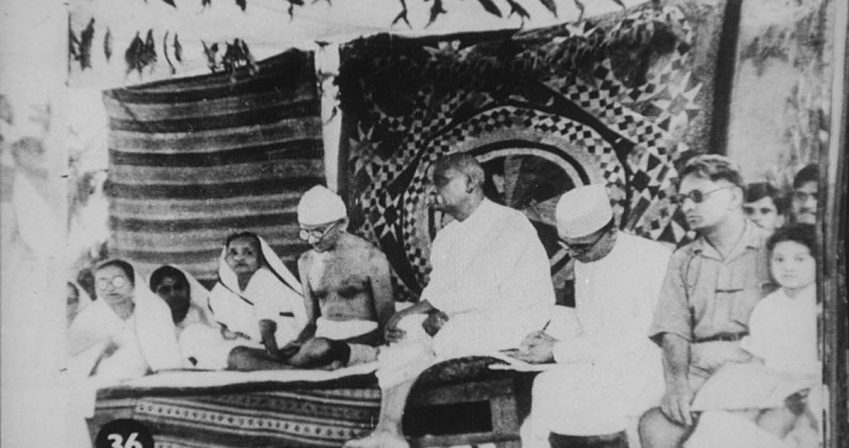
Vallabhbhai Patel with Gandhi during the 1928 Satyagraha
In 1918, when the Bombay government requested full annual tax despite crop failures caused by the previous year’s heavy rain, Vallabhbhai led a mass campaign of peasants, farmers, and landowners in Kaira, Gujarat. His status as a nationalist leader was established in 1928 when he led resistance of increased taxes in Bardoli Stayagraha (major episode of civil disobedience and revolt). He was elected President of the Indian National Congress in 1931 and later became a leading member of the Quit India movement, and was imprisoned on a number of occasions in the 1930s and 1940s.
After India had won its independence, Patel, having played a key role in negotiations and the establishment of the new Republic, he became the first Deputy Prime Minister and Minister for Home Affairs. He died in 1950. A statue of him, completed in 2018, stands facing the Sardar Sarovar Dam in Gujarat, and is the world’s largest statue.