First woman High Court Judge and first woman Bencher
Who We Are
- The Inner Temple Today
- Bench Table Orders
- Education and Qualification Rules
- Consultation Responses
- Time to Change
- Social Mobility Employer Index
- The Council of the Inns of Court
- Anti-Bribery
- Applications Misconduct Policy
- Car Park Terms and Conditions
- Equality & Diversity
- Freedom of Information
- Complaints
- Licensing
- Conflicts of Interest
- Scholarships Travel Reimbursement Policy
- PASS Travel, Accommodation and Subsistence Policy
- Privacy
- Outreach Safeguarding Policy
- 🔗 Searcys Anti-Slavery Policy
- Scholarships Feedback Policy
- Scholarships Deferrals Policy
- Modern Slavery and Human Trafficking Policy
- Environmental Policy
- Scholarships Appeals Policy
- Pupils Advocacy Course Appeals Policy
- Sponsorship for Student Societies
- Social Media for Student Societies
- Volunteer and Participant Code of Conduct
- We Are a Living Wage Employer
- Admissions Database 1547-1940
- The Archives
- Bench Table Orders 1845-1945
- Calendars of Inner Temple Records 1505-1845
- Introduction
- Diversity Timeline
- Edward Akufo-Addo
- Obafemi Awolowo
- Joyce Bamford-Addo
- Solomon Brandaranaike
- Charlotte Boaitey-Kwarteng
- Joseph Ephraim Casely Hayford
- Eugenia Charles
- S Chelvan
- Thomas Morris Chester
- Learie Constantine
- Edward Cragg Haynes
- Patricia Dangor
- Coomee Rustom Dantra
- Gifty Edila
- Ezlynn Deraniyagala
- Taslim Olawale Elias
- Martin Forde
- Arthur Dion Hanna
- Ma Pwa Hmee
- Alexander Isbister
- Sibghatullah Kadri
- Seretse Kharma
- Moleleki Didwell Mokama
- Tunde Okewale
- Ashitey Ollennu
- Vallabhbhai Patel
- Lily Tie Ten Quee
- Ponnambalam Ramanathan
- Edward Richards
- Khushwant Singh
- Manjiit Singh Gill
- Teo Soon Kim
- Leslie Thomas
- Stella Thomas
- Leonard Woodley
- The Christmas Accounts 1614-82
- The Freehold
- Charles and Mary Lamb in the Inner Temple
- Grand Day
- Life in Halls: Designs of the Previous Incarnations of the Inner Temple Hall
- Gorboduc, or the Tragedy of Ferrex and Porrox
- Lord Robert Dudley, 'chief patron and defender' of the Inner Temple
- Lost in the Past : The Rediscovered Archives of Clifford's Inn
- Paintings
- Phoenix from the Ashes: The Post-War Reconstruction Of The Inner Temple
- Silver - Extract from 'A Community of Communities'
- The "Unfortunate Marriage" of Seretse Khama
- The admission of overseas students to the Inner Temple in the 19th century
- The Inns Of Court & Inns Of Chancery & their Records
- William Cowper of the Inner Temple
- William Niblett - A Life Re-Examined
- History of The Inner Temple Video
- Library Manuscripts
- Magna Carta Timeline
- Paintings Collection
- Pegasus Emblem
- Silver Collection
- Introduction
- Timeline
- Joyce Bamford-Addo
- Marion Billson
- Jill Black
- Elizabeth Butler-Sloss
- Sue Carr
- Eugenia Charles
- Lynda Clark
- Freda Corbet
- Coomee Rustom Dantra
- Leeona Dorrian
- Heather Hallett
- Frene Ginwala
- Rosalyn Higgins
- Daw Phar Hmee
- Lim Beng Hong
- Dorothy Knight Dix
- Sara Lawson
- Elizabeth Lane
- Theodora Llewelyn Davies
- Gladys Ramsarran
- Lucy See
- Evelyn Sharp
- Victoria Sharp
- Ingrid Simler
- Teo Soon Kim
- Ivy Williams
- The Significance of the Sex Disqualification (Removal) Act 1919
- Women in Law Podcasts
- Notable Members
- Our People
- Work for Us
Home › Who We Are › History › Women in Law › Our Women › Elizabeth Lane
Dame Elizabeth Lane DBE
Admitted 1937, Called 1940, Bencher 1965
Elizabeth Lane was born on the 9 August 1905 in Bowden, Cheshire the daughter of Edward Coulborn and Kate Wilkinson. After being educated by governesses and tutors, she boarded at Twizzletwig School in Hindhead from the age of thirteen and then attended Malvern Girls’ College from the age of fifteen. She later described herself as “not the studious kind”, much preferring games, particularly hockey to school work. She chose not to go to University, planning that once leaving school she would
have done with academics and have a good time.
In 1924 Lane went to Montreal to stay with her older brother, Rushton. While there she met his friend Randall Lane; within three weeks they were engaged. They were married in Didsbury Parish Church, Manchester on 14 January 1926. They had one son, John, born in August 1928; as a toddler he suffered brain damage as a result of epilepsy and he had died of pneumonia at the age of fourteen.
In 1936 Randall decided to read for the Bar. When Lane became interested in the material he was studying, he said that she knew the material better than he did and should become a barrister herself. In November 1937 Lane became a student member of the Inner Temple, and the two studied law together. Lane sat and passed her final examinations in October 1939 and was called to the Bar the following summer. After a pupillage under Geoffrey Howard, she began practising on the Midland Circuit where her main interest was in civil work.
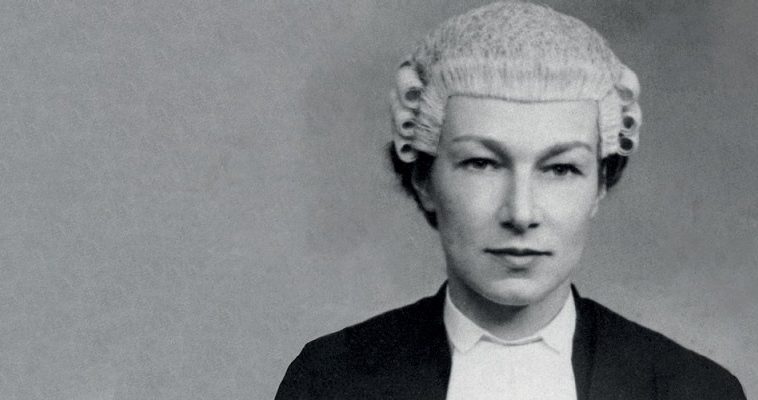
Dame Elizabeth Lane
Lane’s legal career involved many firsts: after becoming a KC in 1950 (only the third woman to do so) she was the first woman to be appointed Recorder of Derby in 1961, the first woman to be appointed a County Court judge in 1962, and the first woman to be appointed a judge of the High Court in 1965, when she became a Bencher of the Inner Temple in 1965, she was the first female Bencher of any Inn. This sometimes led to logistical problems. Having agitated for a separate robing room (she was initially expected to share the men’s) she notes that county courts sometimes had difficulties with this.
In one of them my persistence was rewarded by the exclusive use of a room on the door of which was large notice ‘GAS KEEP OUT’.
Despite these difficulties, she said that
once I had become an established practitioner I think that I was treated in the same way as any other member of the Bar.
Upon her appointment to the High Court Lane was made DBE; her husband had previously been made CBE for his work as legal advisor to the British Council. She was assigned to the Probate, Divorce and Admiralty Division, which later became the Family Division. In 1971 she was asked to the chair the committee to review the working of the 1967 Abortion Act and wrote the majority of Volume 1 of its report herself. Lane retired in 1979, four years after Randall’s death. She moved out of the Temple to Winchester, returning to London from time to time to sit as an additional member of the Court of Appeal. She was made an Honorary member of the Western Circuit, allowing her to attend Circuit dinners and greatly enjoyed having a garden, which had not been possible in London. In 1986 she became an Honorary Fellow of Newnham College, Cambridge, a women only college; she always encourage young women considering a career at the Bar. She died in Winchester on 17 June 1988.