First woman to practise as a barrister in Burma
Who We Are
- The Inner Temple Today
- Bench Table Orders
- Education and Qualification Rules
- Consultation Responses
- Time to Change
- Social Mobility Employer Index
- The Council of the Inns of Court
- Anti-Bribery
- Applications Misconduct Policy
- Car Park Terms and Conditions
- Equality & Diversity
- Freedom of Information
- Complaints
- Licensing
- Conflicts of Interest
- Scholarships Travel Reimbursement Policy
- PASS Travel, Accommodation and Subsistence Policy
- Privacy
- Outreach Safeguarding Policy
- 🔗 Searcys Anti-Slavery Policy
- Scholarships Feedback Policy
- Scholarships Deferrals Policy
- Modern Slavery and Human Trafficking Policy
- Environmental Policy
- Scholarships Appeals Policy
- Pupils Advocacy Course Appeals Policy
- Sponsorship for Student Societies
- Social Media for Student Societies
- Volunteer and Participant Code of Conduct
- We Are a Living Wage Employer
- Admissions Database 1547-1940
- The Archives
- Bench Table Orders 1845-1945
- Calendars of Inner Temple Records 1505-1845
- Introduction
- Diversity Timeline
- Edward Akufo-Addo
- Obafemi Awolowo
- Joyce Bamford-Addo
- Solomon Brandaranaike
- Charlotte Boaitey-Kwarteng
- Joseph Ephraim Casely Hayford
- Eugenia Charles
- S Chelvan
- Thomas Morris Chester
- Learie Constantine
- Edward Cragg Haynes
- Patricia Dangor
- Coomee Rustom Dantra
- Gifty Edila
- Ezlynn Deraniyagala
- Taslim Olawale Elias
- Martin Forde
- Arthur Dion Hanna
- Ma Pwa Hmee
- Alexander Isbister
- Sibghatullah Kadri
- Seretse Kharma
- Moleleki Didwell Mokama
- Tunde Okewale
- Ashitey Ollennu
- Vallabhbhai Patel
- Lily Tie Ten Quee
- Ponnambalam Ramanathan
- Edward Richards
- Khushwant Singh
- Manjiit Singh Gill
- Teo Soon Kim
- Leslie Thomas
- Stella Thomas
- Leonard Woodley
- The Christmas Accounts 1614-82
- The Freehold
- Charles and Mary Lamb in the Inner Temple
- Grand Day
- Life in Halls: Designs of the Previous Incarnations of the Inner Temple Hall
- Gorboduc, or the Tragedy of Ferrex and Porrox
- Lord Robert Dudley, 'chief patron and defender' of the Inner Temple
- Lost in the Past : The Rediscovered Archives of Clifford's Inn
- Paintings
- Phoenix from the Ashes: The Post-War Reconstruction Of The Inner Temple
- Silver - Extract from 'A Community of Communities'
- The "Unfortunate Marriage" of Seretse Khama
- The admission of overseas students to the Inner Temple in the 19th century
- The Inns Of Court & Inns Of Chancery & their Records
- William Cowper of the Inner Temple
- William Niblett - A Life Re-Examined
- History of The Inner Temple Video
- Library Manuscripts
- Magna Carta Timeline
- Paintings Collection
- Pegasus Emblem
- Silver Collection
- Introduction
- Timeline
- Joyce Bamford-Addo
- Marion Billson
- Jill Black
- Elizabeth Butler-Sloss
- Sue Carr
- Eugenia Charles
- Lynda Clark
- Freda Corbet
- Coomee Rustom Dantra
- Leeona Dorrian
- Heather Hallett
- Frene Ginwala
- Rosalyn Higgins
- Daw Phar Hmee
- Lim Beng Hong
- Dorothy Knight Dix
- Sara Lawson
- Elizabeth Lane
- Theodora Llewelyn Davies
- Gladys Ramsarran
- Lucy See
- Evelyn Sharp
- Victoria Sharp
- Ingrid Simler
- Teo Soon Kim
- Ivy Williams
- The Significance of the Sex Disqualification (Removal) Act 1919
- Women in Law Podcasts
- Notable Members
- Our People
- Work for Us
Home › Who We Are › History › Women in Law › Our Women › Daw Phar Hmee
Daw Phar Hmee
Admitted 1924, Called 1926
Was admitted to the Inn on 25 January 1924. As a strong supporter of women’s rights, she initially decided to become a lawyer in order to benefit the women of Burma, believing that:
One of her letters of testimonial for entry to this Inn was written by the former Lieutenant Governor of Burma Harvey Adamson, who stated that:
her family is well known and respected in Burma. Her father holds a position of trust in Rangoon Municipality. Ma Pwa Hmee has come to England to study for the Bar, an enterprise which I believe no other Burmese lady has hitherto undertaken. From what I see and hear I am confident she is worthy of encouragement.
She was called to the Bar on 17 November 1926. As only one of two women to be called to the Bar she attracted the attention of the press and was interviewed, providing us with a description on London and Londoners through the eyes of a Burmese student in London:
Never in my life had I seen people in such a hurry as those tearing down the streets of London. I thought that their haste must be due to some special attraction in the next street. In one of the busy streets of the West End I remember waiting five or ten minutes to cross the road, and expecting the traffic to wait for me. Another of my difficulties was in understanding the language of the bus conductor who several times told me to ‘Ole tight’. [1]
She also mentioned the dress of the British girl:
the bearing of the British people, their erect bodies and even strides which show they have loved for generations long walks in the open air. [2]
On December 10 she boarded the boat to Rangoon and in 1927 she became the first woman to be called to the Bar in Rangoon.
Eight years later in February 1935 she made history again when she was appointed one of the first Honorary Magistrates in Rangoon
She married U Myint Thein, also a barrister and called to the Bar at Lincoln’s Inn in 1925 and Chief Justice in Burma from 1957 to 1962.
[1] Woman Barrister form Burma, Dundee Courier, 10 December 1926
[2] The Daily Telegraph, 18 November 1926
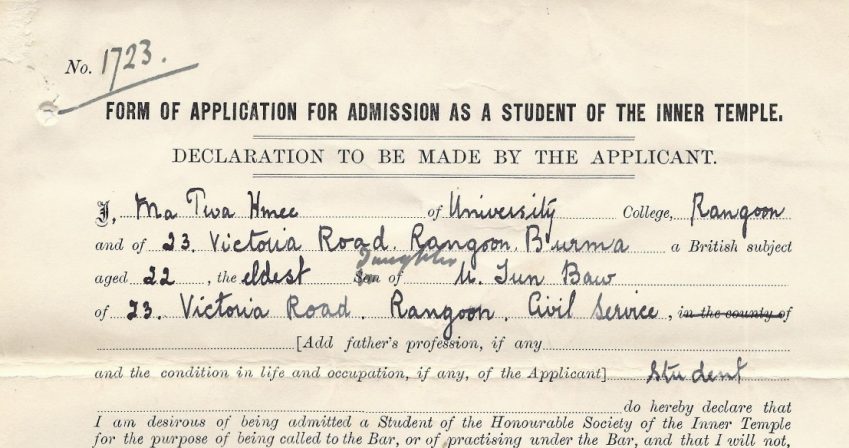
Ma Pwa Hmee's Admission Form