The first woman along with Frances Kyle to be called to the Irish Bar
Who We Are
- The Inner Temple Today
- Bench Table Orders
- Education and Qualification Rules
- Consultation Responses
- Time to Change
- Social Mobility Employer Index
- The Council of the Inns of Court
- Anti-Bribery
- Applications Misconduct Policy
- Car Park Terms and Conditions
- Equality & Diversity
- Freedom of Information
- Complaints
- Licensing
- Conflicts of Interest
- Scholarships Travel Reimbursement Policy
- PASS Travel, Accommodation and Subsistence Policy
- Privacy
- Outreach Safeguarding Policy
- 🔗 Searcys Anti-Slavery Policy
- Scholarships Feedback Policy
- Scholarships Deferrals Policy
- Modern Slavery and Human Trafficking Policy
- Environmental Policy
- Scholarships Appeals Policy
- Pupils Advocacy Course Appeals Policy
- Sponsorship for Student Societies
- Social Media for Student Societies
- Volunteer and Participant Code of Conduct
- We Are a Living Wage Employer
- Admissions Database 1547-1940
- The Archives
- Bench Table Orders 1845-1945
- Calendars of Inner Temple Records 1505-1845
- Introduction
- Diversity Timeline
- Edward Akufo-Addo
- Obafemi Awolowo
- Joyce Bamford-Addo
- Solomon Brandaranaike
- Charlotte Boaitey-Kwarteng
- Joseph Ephraim Casely Hayford
- Eugenia Charles
- S Chelvan
- Thomas Morris Chester
- Learie Constantine
- Edward Cragg Haynes
- Patricia Dangor
- Coomee Rustom Dantra
- Gifty Edila
- Ezlynn Deraniyagala
- Taslim Olawale Elias
- Martin Forde
- Arthur Dion Hanna
- Ma Pwa Hmee
- Alexander Isbister
- Sibghatullah Kadri
- Seretse Kharma
- Moleleki Didwell Mokama
- Tunde Okewale
- Ashitey Ollennu
- Vallabhbhai Patel
- Lily Tie Ten Quee
- Ponnambalam Ramanathan
- Edward Richards
- Khushwant Singh
- Manjiit Singh Gill
- Teo Soon Kim
- Leslie Thomas
- Stella Thomas
- Leonard Woodley
- The Christmas Accounts 1614-82
- The Freehold
- Charles and Mary Lamb in the Inner Temple
- Grand Day
- Life in Halls: Designs of the Previous Incarnations of the Inner Temple Hall
- Gorboduc, or the Tragedy of Ferrex and Porrox
- Lord Robert Dudley, 'chief patron and defender' of the Inner Temple
- Lost in the Past : The Rediscovered Archives of Clifford's Inn
- Paintings
- Phoenix from the Ashes: The Post-War Reconstruction Of The Inner Temple
- Silver - Extract from 'A Community of Communities'
- The "Unfortunate Marriage" of Seretse Khama
- The admission of overseas students to the Inner Temple in the 19th century
- The Inns Of Court & Inns Of Chancery & their Records
- William Cowper of the Inner Temple
- William Niblett - A Life Re-Examined
- History of The Inner Temple Video
- Library Manuscripts
- Magna Carta Timeline
- Paintings Collection
- Pegasus Emblem
- Silver Collection
- Introduction
- Timeline
- Joyce Bamford-Addo
- Marion Billson
- Jill Black
- Elizabeth Butler-Sloss
- Sue Carr
- Eugenia Charles
- Lynda Clark
- Freda Corbet
- Coomee Rustom Dantra
- Leeona Dorrian
- Heather Hallett
- Frene Ginwala
- Rosalyn Higgins
- Daw Phar Hmee
- Lim Beng Hong
- Dorothy Knight Dix
- Sara Lawson
- Elizabeth Lane
- Theodora Llewelyn Davies
- Gladys Ramsarran
- Lucy See
- Evelyn Sharp
- Victoria Sharp
- Ingrid Simler
- Teo Soon Kim
- Ivy Williams
- The Significance of the Sex Disqualification (Removal) Act 1919
- Women in Law Podcasts
- Notable Members
- Our People
- Work for Us
Home › Who We Are › History › Women in Law › Pioneering Women in Law › Averil Deverill
Averil Deverell
Listen to Liz Goldthorpe Talk About Averil Deverell
play_arrow
pause
0:00
-0:00
volume_up
volume_down
volume_off
1893 – 1979
Averil Katherine Statter Deverell was born a twin on 2 January 1893 in Dublin. Averil was the only daughter of Ada Kate Statter Carr (1864-1952), and William Deverell (1862-1934). Her solicitor father, a brewer’s son of Anglo-Irish, Protestant Unionist stock, was Clerk of the Crown and Peace for Co. Wicklow. Her mother was the daughter of a wealthy London solicitor from a British mercantile family in St Petersburg. Lawyers featured on both sides of the family.
Initially taught by an English governess, Averil went to the local girls Protestant French School in Bray, Co. Wicklow - good citizens, homemakers, and professional careers were all its goals. Her brother William Berenger Statter Deverell (1893-1966 OBE) went away to boys boarding school.
Averil’s love of drama emerged in roles in school Shakespeare, a suffragette play in January 1911 and Dublin University Dramatic Society performances at the Gaiety Theatre. Well-connected Anglo-Irish families and presentation at a Royal court in Dublin Castle in July 1911 were features of her social life.
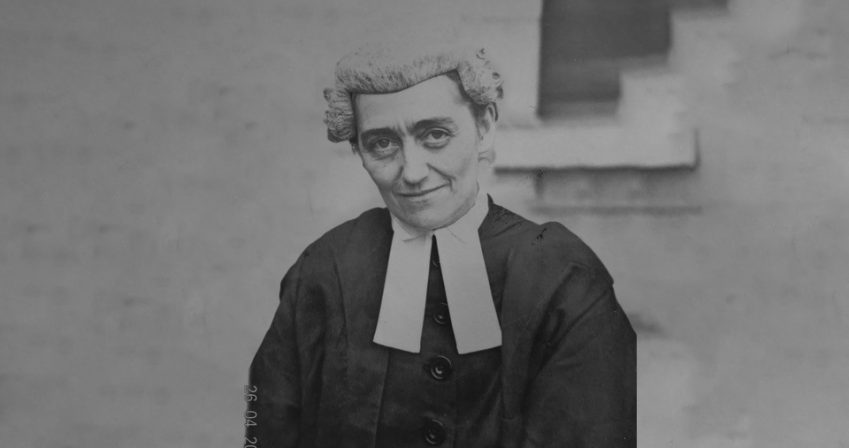
Averil in wig (date unknown) copyright personal collection of Liz Goldthorpe 2019
Trinity College Dublin undergraduates in 1911, the twins joined Fay Kyle and other early women students (admitted on equal terms in 1904) and got LLBs in 1915. In 1912 she joined Trinity’s St John Ambulance VAD unit and completed over 3,000 hours war service. Taught to drive by her father, she was finally accepted as an ambulance driver, serving in France from July to December 1918.
In Autumn 1919, encouraged by her father, Averil joined Fay to read for the Bar at King’s Inns. By a narrow margin Benchers granted her an exemption from the full commons requirement, in recognition of her war service.
On 1 November 1921 Averil and Fay were called at the Four Courts in Dublin. International headlines heralded them as the first two women barristers in the UK - of which Ireland was still part. Fay was first and Averil fifteenth, with eighteen men including her twin William.
In January 1922 Averil joined the Law Library at the Four Courts, a very different experience from her paternal cousin Naomi Constance Wallace (1891–1980) one of the ten women called at Middle Temple in November 1922, and lifelong Trinity friends Ida May Coffin Duncan OBE and Kathleen Anna Burgess (called Middle Temple 1923 and 1927 respectively).
A few months later civil war erupted, destroying wigs, robes, books, briefs and buildings and forcing the Library’s relocation to Dublin Castle until October 1931.
April 1922 brought her first brief, (which funded the purchase of a cairn terrier and kennels to supplement her earnings) and then appointment as first secretary of the Dublin University Graduate Women’s Association, affiliated to the International Federation of University Women.
She was the lone woman at the Law Library until June 1923 when Mary Dillon-Leetch joined her.
In July 1924 both attended an historic King’s Inns dinner: the 250 guests included some of the first American women lawyers and judges. The Irish trickle was slow: Frances Moran in November 1924 (first woman silk 1941, eight years before Helena Normanton), was followed by the 40 year old suffragist Marion Duggan in June 1925. The third woman LLB at Trinity (1910), shortage of funds probably prevented Marion from being the first called. An average of two admissions annually thereafter and by 1930, only five women were still in practice.
In an eventful and successful career, Averil built up a steady flow of property, probate, and personal injury work with regular court appearances and numerous written opinions. Unusually, she was also regularly instructed for trade unionists, acting as defence counsel for workers fighting for improved working conditions.
In March 1926 she became the first Irishwoman to write a law report.
In 1928 she chalked up another milestone, appearing as a junior to Alfred Dickie KC before the Judicial Committee of the Privy Council in London (in a leading Irish constitutional law case that provoked the first revision of the Anglo-Irish Treaty).
She was the first, and last, Irishwoman to get the customary, coveted, red brief-bag.
Averil remained in practice for more than forty years, mentoring and supervising a small, very diverse coterie of women well into old age, becoming ‘Mother of the Bar’ as the longest serving Law Library member. Campaigning for the return of the women’s robing room in the 1930s, she insisted on a change of sign from ‘Lady’ to ‘Women’ Barristers’. Co-opted to the Bar Council in 1959, it made her an honorary life member in 1970.
Junior to a varied range of men who progressed to senior, and judicial, appointment, Averil never sought silk herself, possibly for family reasons: her father died in 1934 and her brother, who had chosen a military career, was rarely at home.
Colourful, popular, but reserved, until retirement in 1969 aged 76 Averil regularly attended the Law Library, driving from home in her ‘souped-up’ Triumph Herald, claiming her unofficial parking space and robing room chair.
She had negotiated a life, career and identity in challenging times, earning respect and affection in equal measure.
Living in the family home in Greystones, Co. Wicklow from 1910 to 1975, (her Brigadier brother died there in 1966), she died in a modern bungalow on 11 February 1979. (The year her friend Mella was elected first woman Chair of Bar Council). Averil’s bequest to Trinity Law School funded the post of Averil Deverell Lecturer in Law (first holder Fidelma Macken, first woman judge European Court of Justice). The portrait she donated hangs in the Law Library, a barristers’ room is named after her, and a biography is in preparation.