Industrial welfare promoter and barrister
Who We Are
- The Inner Temple Today
- Bench Table Orders
- Education and Qualification Rules
- Consultation Responses
- Time to Change
- Social Mobility Employer Index
- The Council of the Inns of Court
- Anti-Bribery
- Applications Misconduct Policy
- Car Park Terms and Conditions
- Equality & Diversity
- Freedom of Information
- Complaints
- Licensing
- Conflicts of Interest
- Scholarships Travel Reimbursement Policy
- PASS Travel, Accommodation and Subsistence Policy
- Privacy
- Outreach Safeguarding Policy
- 🔗 Searcys Anti-Slavery Policy
- Scholarships Feedback Policy
- Scholarships Deferrals Policy
- Modern Slavery and Human Trafficking Policy
- Environmental Policy
- Scholarships Appeals Policy
- Pupils Advocacy Course Appeals Policy
- Sponsorship for Student Societies
- Social Media for Student Societies
- Volunteer and Participant Code of Conduct
- We Are a Living Wage Employer
- Admissions Database 1547-1940
- The Archives
- Bench Table Orders 1845-1945
- Calendars of Inner Temple Records 1505-1845
- Introduction
- Diversity Timeline
- Edward Akufo-Addo
- Obafemi Awolowo
- Joyce Bamford-Addo
- Solomon Brandaranaike
- Charlotte Boaitey-Kwarteng
- Joseph Ephraim Casely Hayford
- Eugenia Charles
- S Chelvan
- Thomas Morris Chester
- Learie Constantine
- Edward Cragg Haynes
- Patricia Dangor
- Coomee Rustom Dantra
- Gifty Edila
- Ezlynn Deraniyagala
- Taslim Olawale Elias
- Martin Forde
- Arthur Dion Hanna
- Ma Pwa Hmee
- Alexander Isbister
- Sibghatullah Kadri
- Seretse Kharma
- Moleleki Didwell Mokama
- Tunde Okewale
- Ashitey Ollennu
- Vallabhbhai Patel
- Lily Tie Ten Quee
- Ponnambalam Ramanathan
- Edward Richards
- Khushwant Singh
- Manjiit Singh Gill
- Teo Soon Kim
- Leslie Thomas
- Stella Thomas
- Leonard Woodley
- The Christmas Accounts 1614-82
- The Freehold
- Charles and Mary Lamb in the Inner Temple
- Grand Day
- Life in Halls: Designs of the Previous Incarnations of the Inner Temple Hall
- Gorboduc, or the Tragedy of Ferrex and Porrox
- Lord Robert Dudley, 'chief patron and defender' of the Inner Temple
- Lost in the Past : The Rediscovered Archives of Clifford's Inn
- Paintings
- Phoenix from the Ashes: The Post-War Reconstruction Of The Inner Temple
- Silver - Extract from 'A Community of Communities'
- The "Unfortunate Marriage" of Seretse Khama
- The admission of overseas students to the Inner Temple in the 19th century
- The Inns Of Court & Inns Of Chancery & their Records
- William Cowper of the Inner Temple
- William Niblett - A Life Re-Examined
- History of The Inner Temple Video
- Library Manuscripts
- Magna Carta Timeline
- Paintings Collection
- Pegasus Emblem
- Silver Collection
- Introduction
- Timeline
- Joyce Bamford-Addo
- Marion Billson
- Jill Black
- Elizabeth Butler-Sloss
- Sue Carr
- Eugenia Charles
- Lynda Clark
- Freda Corbet
- Coomee Rustom Dantra
- Leeona Dorrian
- Heather Hallett
- Frene Ginwala
- Rosalyn Higgins
- Daw Phar Hmee
- Lim Beng Hong
- Dorothy Knight Dix
- Sara Lawson
- Elizabeth Lane
- Theodora Llewelyn Davies
- Gladys Ramsarran
- Lucy See
- Evelyn Sharp
- Victoria Sharp
- Ingrid Simler
- Teo Soon Kim
- Ivy Williams
- The Significance of the Sex Disqualification (Removal) Act 1919
- Women in Law Podcasts
- Notable Members
- Our People
- Work for Us
Home › Who We Are › History › Women in Law › Pioneering Women in Law › Gladys Chatterjee
Lady Gladys Chatterjee OBE
(1883–1969)
Chatterjee (née Broughton) was called to the Bar at Lincoln’s Inn in January 1933. She was born in Ujjain, Madhya Pradesh, India, on 30 October 1883. Her father was an army captain, William Barnard Broughton and her mother was Emily Angelina, daughter of Sir Michael Filose, of Gwalior, an official of the British administration in India.
After the death of Gladys Broughton’s father, her widowed mother returned to England, where she worked as a nurse in the London Hospital, before marrying Ernest Frederick Cambier, a lieutenant-colonel in the Royal Artillery. They returned to India, but settled finally in England in 1901. Chatterjee was enrolled as a pupil at Bedford high school and then later at University College, London. She won many scholarships: the Gilchrist scholarship in psychology and logic (1906), the John Stuart Mill scholarship in philosophy (1908), and the Joseph Hume and Ricardo scholarships (both 1910) in political economy. In 1907 she graduated with a B.A from the University of London BA and in 1909 with an MA in philosophy in 1909. In 1912 she entered Bedford College for Women, London, where she joined the teacher training department. After gaining a University of London teacher’s diploma, she was for a time in 1912 a special investigator for the Board of Trade.
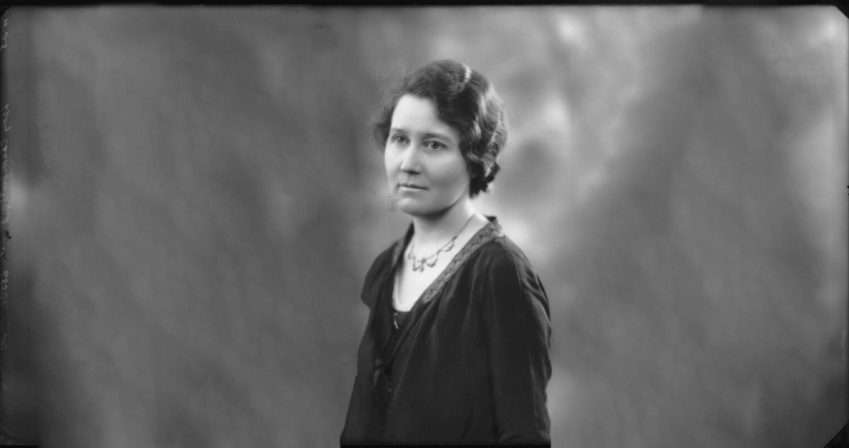
Lady Gladys Mary Chatterjee (née Broughton) by Bassano Ltd. Image: https://www.npg.org.uk/collections/search/portrait/mw71714/
From 1913 to 1916 Gladys Broughton was in India as inspector of schools in the Central Provinces of India under the Indian educational service. Returning to Britain, she became head welfare officer at the Ministry of Munitions from 1916 to 1918, and, in 1917 she was awarded with an OBE in the first honours list for the newly created Order of the British Empire. This was for her work as ‘organiser of women’s welfare in national shell and national projectile factories’ (London Gazette, 24 Aug 1917).
From 1918 to 1920 she was an investigator to the Industrial Fatigue Research Board. With Edith Allen and Ethel May Newbold she published A Statistical Study of the Turnover in Munitions and Other Factories (Reports of the Industrial Fatigue Research Board, 13, 1921). From 1920 to 1923 she was in India as an adviser to the department of labour of the government of India. She had enrolled at the London School of Economics in 1919, and in 1924 was awarded the degree of DSc (Econ) for her thesis, published as Labour in Indian Industries (1924).
On 30 April 1924, at Kensington register office, she married the widower Atul Chandra Chatterjee, an Indian civil servant, who was a member of the viceroy’s executive council in charge of the department of industries and labour.
Settling in England in 1925 on her husband’s appointment as high commissioner for India, a position he held for six years, he erected India House in Aldwych. He was knighted on taking up the appointment in January 1925 and she became Lady Chatterjee.
She was called to the Bar at Lincoln’s Inn in January 1933. Despite third-class passes in many of her Bar exams she worked in common law and privy council chambers, practising in the probate, divorce, and Admiralty courts. She appeared before the Judicial Committee of the privy council in some Indian and Ceylon appeals and was counsel for the Legal Aid Committee for Poor Persons. During the Second World War she acted as counsel for the service department of the Law Society in divorce cases.
She died at Birtley House, Bramley, Surrey, on 7 May 1969.