First woman to join an Inn, first woman to practice at the Bar, first woman to appear in the High Court, first woman to appear in the Old Bailey and one of the two first women KCs in England and Wales
Who We Are
- The Inner Temple Today
- Bench Table Orders
- Education and Qualification Rules
- Consultation Responses
- Time to Change
- Social Mobility Employer Index
- The Council of the Inns of Court
- Anti-Bribery
- Applications Misconduct Policy
- Car Park Terms and Conditions
- Equality & Diversity
- Freedom of Information
- Complaints
- Licensing
- Conflicts of Interest
- Scholarships Travel Reimbursement Policy
- PASS Travel, Accommodation and Subsistence Policy
- Privacy
- Outreach Safeguarding Policy
- 🔗 Searcys Anti-Slavery Policy
- Scholarships Feedback Policy
- Scholarships Deferrals Policy
- Modern Slavery and Human Trafficking Policy
- Environmental Policy
- Scholarships Appeals Policy
- Pupils Advocacy Course Appeals Policy
- Sponsorship for Student Societies
- Social Media for Student Societies
- Volunteer and Participant Code of Conduct
- We Are a Living Wage Employer
- Admissions Database 1547-1940
- The Archives
- Bench Table Orders 1845-1945
- Calendars of Inner Temple Records 1505-1845
- Introduction
- Diversity Timeline
- Edward Akufo-Addo
- Obafemi Awolowo
- Joyce Bamford-Addo
- Solomon Brandaranaike
- Charlotte Boaitey-Kwarteng
- Joseph Ephraim Casely Hayford
- Eugenia Charles
- S Chelvan
- Thomas Morris Chester
- Learie Constantine
- Edward Cragg Haynes
- Patricia Dangor
- Coomee Rustom Dantra
- Gifty Edila
- Ezlynn Deraniyagala
- Taslim Olawale Elias
- Martin Forde
- Arthur Dion Hanna
- Ma Pwa Hmee
- Alexander Isbister
- Sibghatullah Kadri
- Seretse Kharma
- Moleleki Didwell Mokama
- Tunde Okewale
- Ashitey Ollennu
- Vallabhbhai Patel
- Lily Tie Ten Quee
- Ponnambalam Ramanathan
- Edward Richards
- Khushwant Singh
- Manjiit Singh Gill
- Teo Soon Kim
- Leslie Thomas
- Stella Thomas
- Leonard Woodley
- The Christmas Accounts 1614-82
- The Freehold
- Charles and Mary Lamb in the Inner Temple
- Grand Day
- Life in Halls: Designs of the Previous Incarnations of the Inner Temple Hall
- Gorboduc, or the Tragedy of Ferrex and Porrox
- Lord Robert Dudley, 'chief patron and defender' of the Inner Temple
- Lost in the Past : The Rediscovered Archives of Clifford's Inn
- Paintings
- Phoenix from the Ashes: The Post-War Reconstruction Of The Inner Temple
- Silver - Extract from 'A Community of Communities'
- The "Unfortunate Marriage" of Seretse Khama
- The admission of overseas students to the Inner Temple in the 19th century
- The Inns Of Court & Inns Of Chancery & their Records
- William Cowper of the Inner Temple
- William Niblett - A Life Re-Examined
- History of The Inner Temple Video
- Library Manuscripts
- Magna Carta Timeline
- Paintings Collection
- Pegasus Emblem
- Silver Collection
- Introduction
- Timeline
- Joyce Bamford-Addo
- Marion Billson
- Jill Black
- Elizabeth Butler-Sloss
- Sue Carr
- Eugenia Charles
- Lynda Clark
- Freda Corbet
- Coomee Rustom Dantra
- Leeona Dorrian
- Heather Hallett
- Frene Ginwala
- Rosalyn Higgins
- Daw Phar Hmee
- Lim Beng Hong
- Dorothy Knight Dix
- Sara Lawson
- Elizabeth Lane
- Theodora Llewelyn Davies
- Gladys Ramsarran
- Lucy See
- Evelyn Sharp
- Victoria Sharp
- Ingrid Simler
- Teo Soon Kim
- Ivy Williams
- The Significance of the Sex Disqualification (Removal) Act 1919
- Women in Law Podcasts
- Notable Members
- Our People
- Work for Us
Home › Who We Are › History › Women in Law › Pioneering Women in Law › Helena Normanton
Helena Normanton KC
Listen to Dr Judith Bourne Talk About Helena Normanton
play_arrow
pause
0:00
-0:00
volume_up
volume_down
volume_off
(1882–1957)
Helena Normanton was born in East London in 1882. Her parents separated when she was four years old and her mother brought up both Helena and her younger daughter, Ethel, alone. Normanton’s mother took on various employment working as a milliner, publican and finally boarding housekeeper. Normanton’s father died in 1886, possibly through suicide. Normanton was educated as a teacher and her sister as a nurse. In 1894 Normanton experienced what she believed to be sex discrimination, when her mother, during a solicitor’s appointment, failed to understand some legal advice proffered. Normanton was asked to explain the advice to her mother, which she did, and the solicitor exclaimed ‘quite the little lawyer’ and so Normanton decided that she would be.
Normanton made legal history, when on 24 December 1919 she joined the Middle Temple, making her the first woman to make use of the Sex Disqualification (Removal) Act 1919 passed the previous day. She was the first woman to join an institution of the legal profession. Normanton had campaigned fiercely for this legislation. In February 1918 she had applied to join the Middle Temple and was refused. With the help of Claud Schuster, Permanent Secretary to the Lord Chancellor, she appealed this decision, but this was further refused in January 1919. She continued to fight for an end to the male exclusivity of the legal profession by participating in public debates and through writing. When it became clear that the Sex Disqualification (Removal) Bill would receive the Royal Assent, the Middle Temple contacted Normanton, inviting her to join them without delay. Normanton joined on Christmas Eve 1919, the day after the Act became law.
Normanton remained in practice until she retired in 1951, but she had to work hard to do so, for example by writing true crime books or magazine articles to supplement her income. She also worked hard to help many people, including people she had defended who ended up in prison or other women trying to enter the Bar, although she warned them of how difficult a profession it could be. She worked tirelessly to improve divorce law, making it more equal for all. Although she never became a judge, something she desperately wanted to be, she did manage to become a King’s Counsel – one of the two first women KCs in England and Wales in 1949. She had many other firsts, first woman to appear in the High Court, first woman to appear in the Old Bailey but we should remember her as an incredibly resilient woman who pushed for change and equality.
Normanton died in 1957 and her ashes were placed with her husband in Ovingdean churchyard, Sussex.
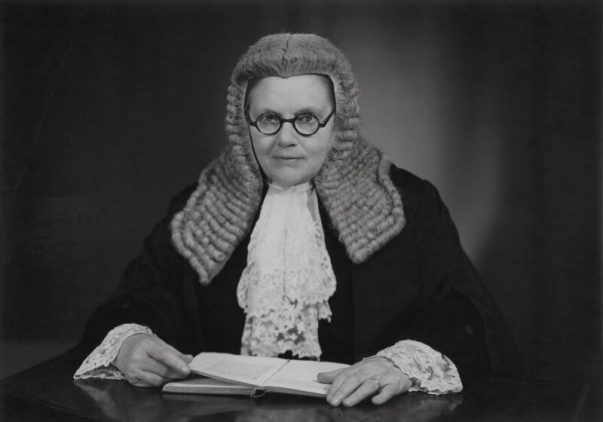
Helena Florence Normanton by Elliott & Fry. Source: https://www.npg.org.uk/collections/search/portrait/mw102407/